

Baniata Leatherbacks
A Solomon Island tourism adventure

I was equal parts excited and terrified when we were told we were going to Baniata.
Excited to see critically endangered leatherback turtles come ashore to nest, naturally. A once-in-a-lifetime opportunity.
Terrified because when even your local counterpart is so scared of the boat ride she refuses to go, you know it’s something to be taken seriously. Solomon Islanders love being at sea, they’re born to it. I am not.
Anyhow, it was decided and that was that. Zaza was off to Japan for a month’s tourism training and was forfeiting her trip in our favour. It wasn’t that the sea was always rough, she told us, you just had to time it right. And we could maybe pray, she added with a cheeky grin. That’s another thing Solomon Islanders do a lot. They go to church.
I was also somewhat put off by the way everyone raved about Baniata’s black sand beach. We’ve had plenty of experience of those kind of beaches and while they’re pretty, they’re also pretty hot. Here in the Solomons, I’m already the hottest I’ve ever been in my life.
Then there are the VSA Health & Safety rules when it comes to riding in small boats. They’ve become very strict ever since a volunteer spent five hours in shark-infested waters waiting to be rescued (or so the story goes), an incident that may well have occurred in these very islands.
First rule: the life jacket - and it’s a bulky, robust one. You look and feel like a neckless sumo wrestler once you’ve managed to click yourself into it. Next comes the PLB (personal locator beacon) which, if activated, will initiate an international Search & Rescue event, something I’m terrified of inadvertently doing. But no, that’s not all. You also have to file a detailed domestic travel report and send a WhatsApp travel notification when you depart and arrive, not always easy when there is no network.
Add to that the hat or cap, lashings of sunscreen and wrap-around sunnies no sensible white fella would venture onto a boat without, and the end result is inelegant to say the least. Laughable actually. But Solomon Islanders are much too polite to mention it. Instead they ride bare-headed with the wind in their hair, a light sarong wrapped around their shoulders, free and easy, and if they’re smiling, it’s because they’re enjoying it so much.
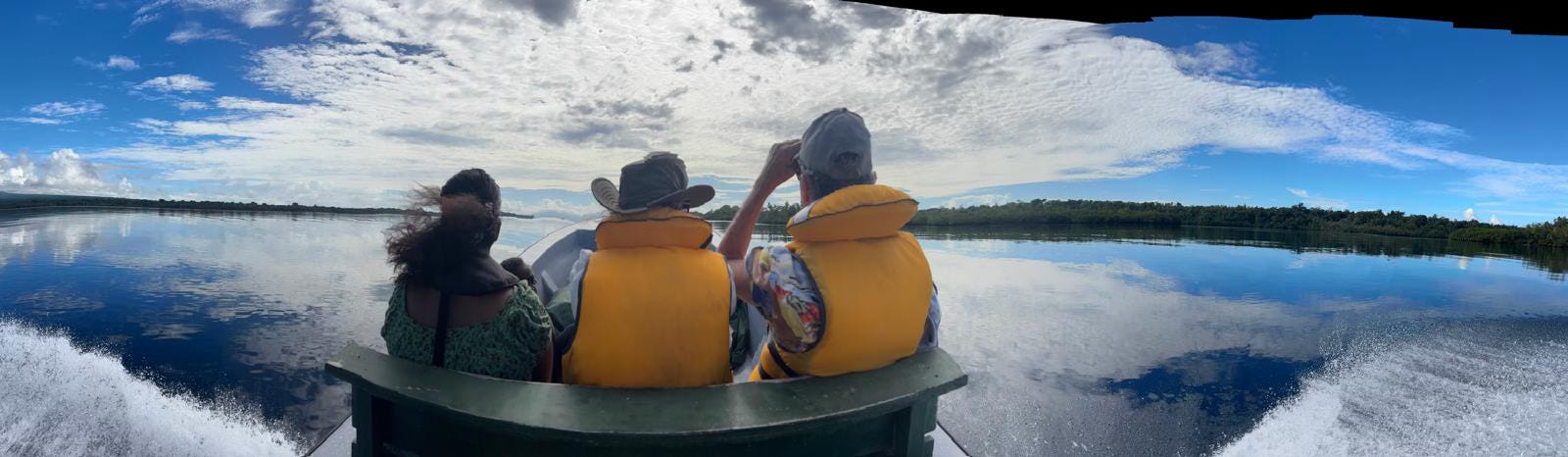
Baniata is on the west coast of Rendova Island, and we’d spent the night before at Titiru Eco Lodge, on the northeastern tip of the same island, in a Robinson-Crusoe overwater bungalow tucked into the mangroves. Now Pana, one of the family who owns the lodge, was taking us to Baniata – by boat, of course, hugging the shoreline. It was late afternoon because that’s when the sea was at its calmest, Pana assured us. We’d overnight in a guesthouse in the village near the turtle nesting site.
While I don’t pray (much) I do see signs, they were everywhere and they were all good. Rain patches swept across the Roviana Lagoon but somehow we avoided getting wet and found ourselves surrounded by rainbows instead. Every now and then a school of bright turquoise flying fish flew alongside us, the quintessential South Sea fantasy for me, my kind of religious experience.
As we rounded a headland, Pana leaned forward and yelled in my ear: ‘Welcome to Western Rendova. It’s a magical place.’ On cue a dolphin leapt out of the water.
We arrived at Baniata in the golden light of late afternoon, the black sand beach warm and welcoming, not sizzling as I’d feared. Locals led us through the village between clusters of stilted houses and meandering flower gardens, to the traditional bungalow where we’d sleep the night.
As soon as we dropped our bags and decanted our life jackets, we were rushed to the hatching grounds. Something special was happening - especially for us, it seemed. The last two baby turtles in a clutch had dug themselves out of their nest and were making their way down to the sea, one sure and in a straight line, the other falling in holes and veering towards the setting sun. Both made it to water’s edge where little waves sucked them out to sea. Maybe, just maybe, they’ll return, twenty years from now, to Baniata, the beach where they were born. Those that make it (a mere ten percent) always come back to nest where it all began.
There’s hardly any twilight this close to the Equator. Night comes quickly and there was just enough light left to inspect the hatching grounds. These were established because the nests on the beach were being raided. Fully fenced to protect the eggs from monitor lizards and dogs, with sticks marking the date and place where each clutch of eggs was buried. When they first started this conservation programme, the villagers told us, the enclosure was very small. Every year since they’ve had to extend it. More and more turtles are coming back. No-one ever eats turtles or their eggs anymore and the leatherback population here is growing.
Turtle rangers keep a nightly vigil. If a turtle does come ashore (and there are no guarantees), it would most likely be in the early hours of the morning. Hopefully not on the far end of the beach, Pana noted, like the last time he was here – that had involved an hour’s walk. Hopefully it wouldn’t be raining. Lots of hopefully-ifs and we were only here for one night.
We’d just settled down under our mosquito nets when we heard Keith’s name being called. A turtle! Already. Come quickly. Not too far down the beach, and no, it wasn’t raining. We stumbled across black sands through the black night canopied by the Milky Way, excited.
How do you even know a turtle has come ashore? I asked the blackness. We hear them breathing, the answer came back. It felt very mystical.
We were totally unprepared for what we saw. I’ve encountered turtles before, but nothing like this. She was enormous, more like a dinosaur than a turtle, breathing great breaths as her powerful flippers, one then the other, rhythmically dug into the sand. It took her ages, digging, stopping to rest, back to it, resting again. A gargantuan effort. First a cavernous hole, the eggs dropping into it one by one, then the laborious covering and firming of the sand above them, followed by more sand flipping to cover her tracks. Slow, steady, methodical. Punctuated by those great puffing breaths.
This was her first time at the beach, the rangers told us, she would come again twice more at three-week intervals to lay. The first clutch is usually the largest. Feel her back, they urged, there’s no shell, it’s smooth like leather. Which it was, segmented by ridges. She seemed oblivious to all but her task.
In the end there were ninety four eggs with yolks and some smaller non-fertile ones there to buffer the others. They were uncovered, lifted and reverently placed in a rice bag. Each time the guide retrieved one his arm and shoulder disappeared into the hole - that’s how deep it was - and the depth was carefully measured.
Back in the hatching grounds, the eggs were buried to that exact depth, important because temperature determines the sex of the turtles. The deeper and cooler it is, the more likely it is they’ll be males.
On the beach, her work done, the great mother made her way down to the sea. Lumbering on land, weightless in the waves, I felt her relief.
The plan was to leave at six the next morning but (Solomon Time and all that) we left at seven. Keith and I were packed and ready long before anyone else and we waited on the beach, watching women bringing baskets of bananas, kumala and ngali nuts to the shoreline to be ferried to the Munda and Honiara markets.
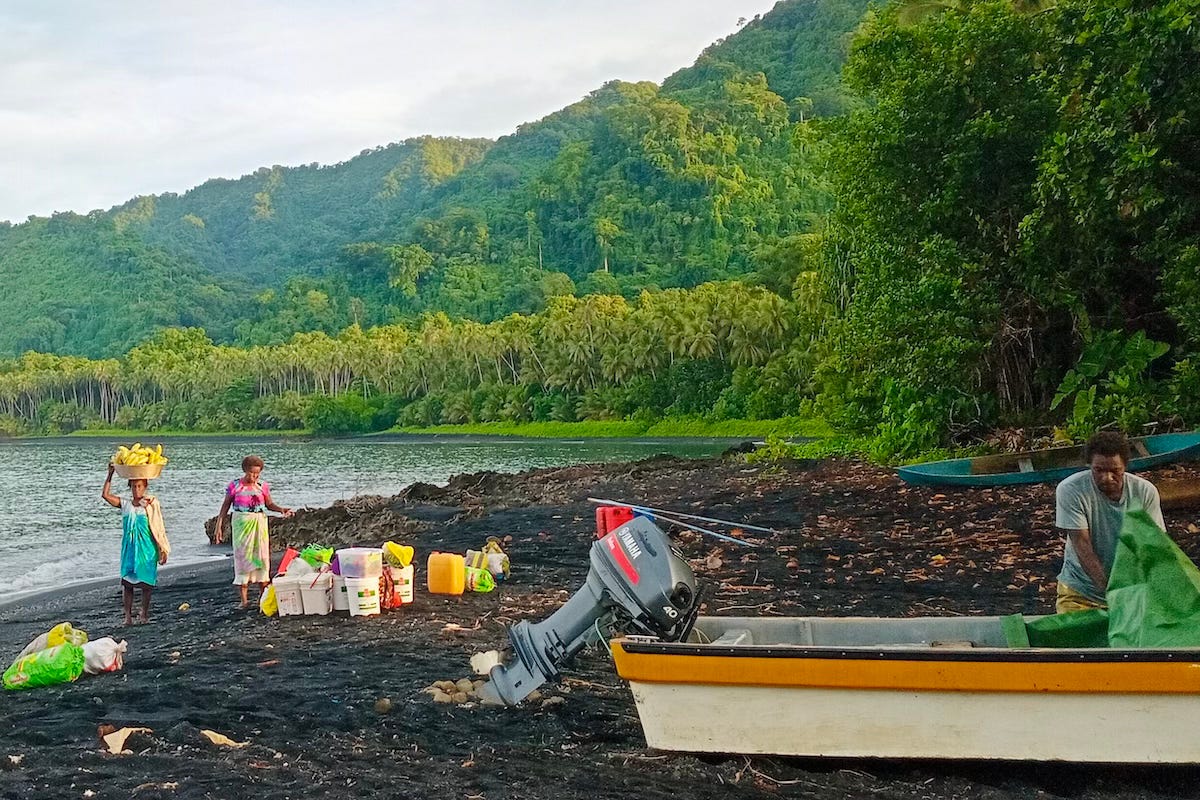
We waded onto our boat at seven, arriving back at Agnes Lodge wharf in the record time of an hour, the smooth-as-glass sea mocking us scaredy-cats as we stripped off our lifejackets and WhatsApp-ed our safe return.
In fifty six days’ time, ninety four turtle eggs will be ready for hatching and ‘our’ babies will follow their mother down to the sea. I see them in my mind’s eye, most heading straight and true, a few veering towards the setting sun.
This is what the Solomons has to offer. This I can sell. The very best kind of tourism experience for the right kind of tourist.
Leatherback Turtle facts:
Nesting season in Baniata is from November to February, hatching continues through to early April
Leatherbacks are critically endangered
Too large to have predators beyond people and great white sharks, they’re mostly taken out by single-use plastic bags which they mistake for jellyfish, their favourite food
Links:
Another Baniata turtle experience and photos here
Very interesting. Reading this in Costa Rica close to a beach where turtles come to hatch. Here, dismayingly imo, there are shacks on that beach, permitted because they have no foundations. But reading your account, I guess these dwellings won't impede the laying.
Hot? Yes!! I have never been so hot in my life, not even in the Kalahari desert . I am longing for the cool waters of Cornwall.
A lovely story well told, Dianne. You’re a great tourism advocate, for sure.